• But they don’t stabilize your knee joint.
• They don’t fix the underlying cause of pain.
• They don’t make your knees stronger.
• Warmth
• Compression
• Sensory feedback (better awareness of joint position)
• Confidence
And that’s okay. The problem starts when you can’t squat without them.
If your knees ache when you’re:
• Walking downstairs
• Getting out of the car
• Standing up from the sofa
• Sitting for long periods
…but they suddenly feel fine after a good warm-up…
The answer probably isn’t more rest.
It may be that your knees need better, more appropriate loading.
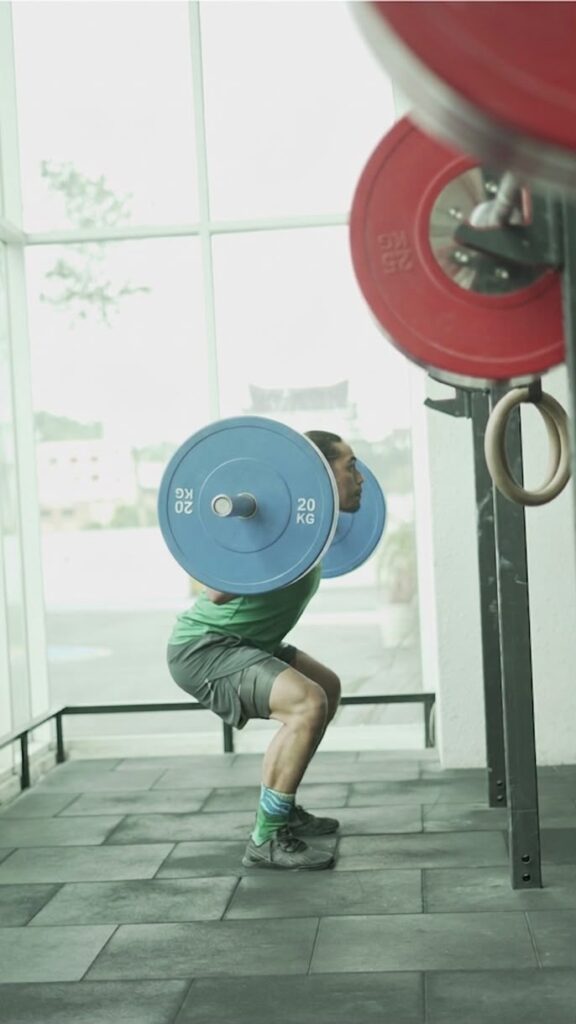
One of the biggest misconceptions in fitness is that squats “ruin your knees.”
For most gym-goers and athletes, that’s usually not the case.
More often, the issue is that the muscles, tendons, or surrounding tissues aren’t prepared for the amount of stress being placed on them.
This commonly happens when you:
• Increase training volume too quickly.
• Jump into high-intensity programs without building a foundation.
• Squat hard several days a week with little recovery.
• Constantly overload the quadriceps and patellar tendon.
The problem isn’t always the squat.
It’s often the capacity of your tissues.
• Pain often decreases when you stop training.
• That doesn’t necessarily mean the tissue has become more resilient.
• If your knee pain returns as soon as you resume normal training, the underlying issue may still be there.
• Rest removes stress. Rehabilitation builds capacity. Those aren’t the same thing.
Usually, it’s not avoiding squats forever.
It’s improving your body’s ability to tolerate them.
That might include:
• Isometric exercises
• Slow eccentric loading
• Single-leg strengthening
• Gradual tendon loading
• Intelligent progression of volume and intensity
Just like muscles, tendons adapt to the loads they’re exposed to, provided those loads are appropriate and progressed over time.
Everyone wants to lift heavier.
Move faster.
Train harder.
But many athletes jump straight into:
• High volume
• High frequency
• High intensity
…without first building the tissue capacity to handle it.
Eventually, the knees start complaining.
• Knee sleeves aren’t the enemy. They’re a tool.
• They can improve comfort, keep the joint warm, and help some athletes feel more confident under heavy loads.
• But they should be an accessory, not a dependency.
• If your knees only feel good when the sleeves are on, it’s worth asking why.
• The goal shouldn’t be to rely on equipment.
• The goal should be to build knees that are resilient with or without it.
• Muscles don’t get stronger overnight.
• Neither do tendons.
• Building resilient tissue takes consistent, progressive exposure to the right amount of stress over time.
• Chasing the fastest gains in strength and power without respecting that process can sometimes increase the risk of setbacks.
Train the tissue.
Build the capacity.
Progress intelligently.
• And don’t expect pain to disappear if you never address the reason it keeps coming back.
Head Coach
Aziz Mohamed
CrossFit Train Blackbox