
Recently, a friend of mine told me he wanted to start dieting and exercising. His goal is to reduce body fat while increasing muscle mass. He already knew that a calorie deficit was the way to go regarding food, and he planned to support that with sports and gym sessions.
However, he asked me a very important question: “Jin, how do I calculate a calorie deficit? How do I know I’m actually in one?”
I realized this is a common question for many people, so I wanted to break it down as simply as possible to help you along your fitness journey.
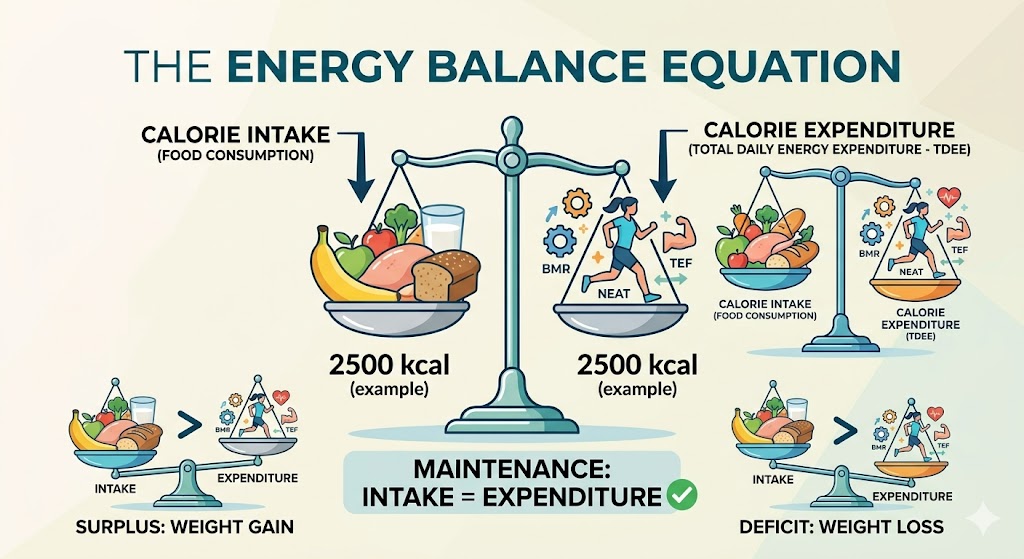
Since my friend’s primary goal is to reduce body fat, his calorie consumption (intake) must be lower than his total calorie expenditure.
Calorie intake is simply the energy value of the food you eat. You can calculate this by totaling the calories of everything you consume per day using online tracking apps like MyFitnessPal. Locally, the Ministry of Health (KKM) has also released a comprehensive list of local foods and their caloric values online.
To find your total expenditure, you need to understand four key values that make up your metabolism.
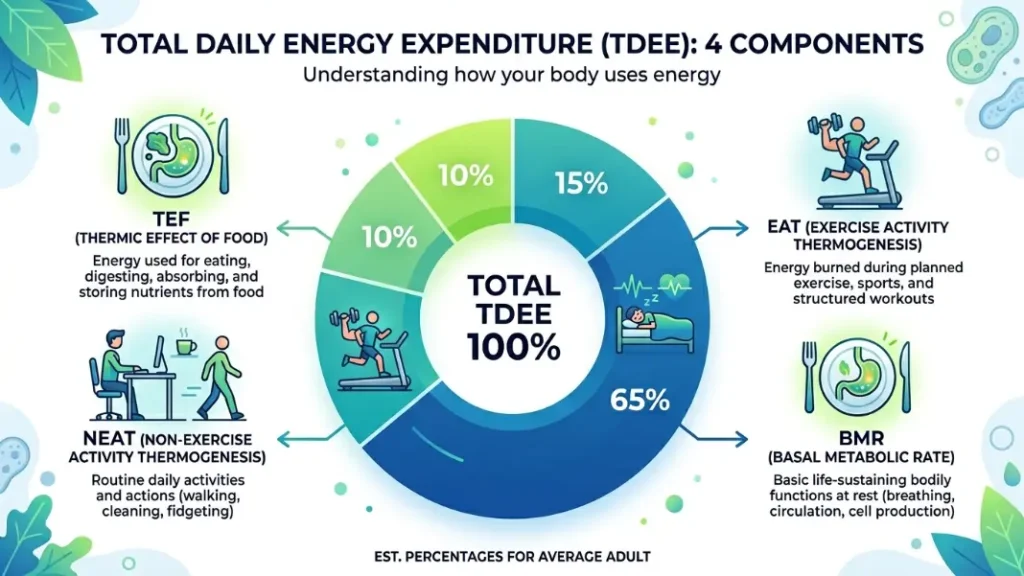
BMR, often referred to as your resting metabolic rate, represents the energy your body expends to maintain essential functions while at complete rest. This includes vital activities like your heartbeat, respiration, cell regeneration, body temperature maintenance, and all the other foundational biological activities required to sustain life when you are inactive.
EAT refers to the energy your body expends during intentional physical activity, such as walking, running, lifting weights, fitness classes, or any other exercise you incorporate into your routine. Contrary to common belief, EAT constitutes a relatively small portion of your total energy expenditure—approximately 5% to 10% on average.
NEAT encompasses the calories burned through your everyday physical movements outside of structured exercise routines. It is the energy your body expends when you engage in activities like cooking, cleaning, shopping, or even fidgeting.
Despite its inconspicuous nature, NEAT holds remarkable potential to influence your metabolic rate. It can contribute up to 15% to 30% of your daily caloric expenditure. While it is not a substitute for vigorous workouts, it is a noteworthy portion of the calories you burn every day.
The Thermic Effect of Food is the energy your body expends during the processes of digesting, absorbing, and metabolizing the food you consume. TEF accounts for roughly 10% of your daily caloric intake. For example, if you consume 2,000 calories, around 200 calories are expended just through eating and digestion.

Your Total Daily Energy Expenditure (TDEE) can be calculated using the following formula:
Therefore, in order to be in a calorie deficit, your total daily calorie intake from food must be strictly less than your TDEE.
You might notice that I have repeatedly used the word estimated. It is incredibly difficult to obtain TDEE and calorie intake data that is 100% accurate due to a variety of real-world variables. Food labels can have minor discrepancies, and fitness trackers use generalized algorithms.
Because of this, the best way to know if you are truly in a deficit is to track your progress consistently over 2 to 3 weeks. If your average weight and body measurements are gradually decreasing while your energy levels remain stable, you are on the right track.
TIPS: A safe and sustainable calorie deficit is 300-500 calorie below your TDEE.
If this breakdown helps you, please share this blog post with a friend who might benefit from it.
If you have further questions about setting up your nutrition or structuring your training, feel free to hit me up via email at jin@blackbox.fit.